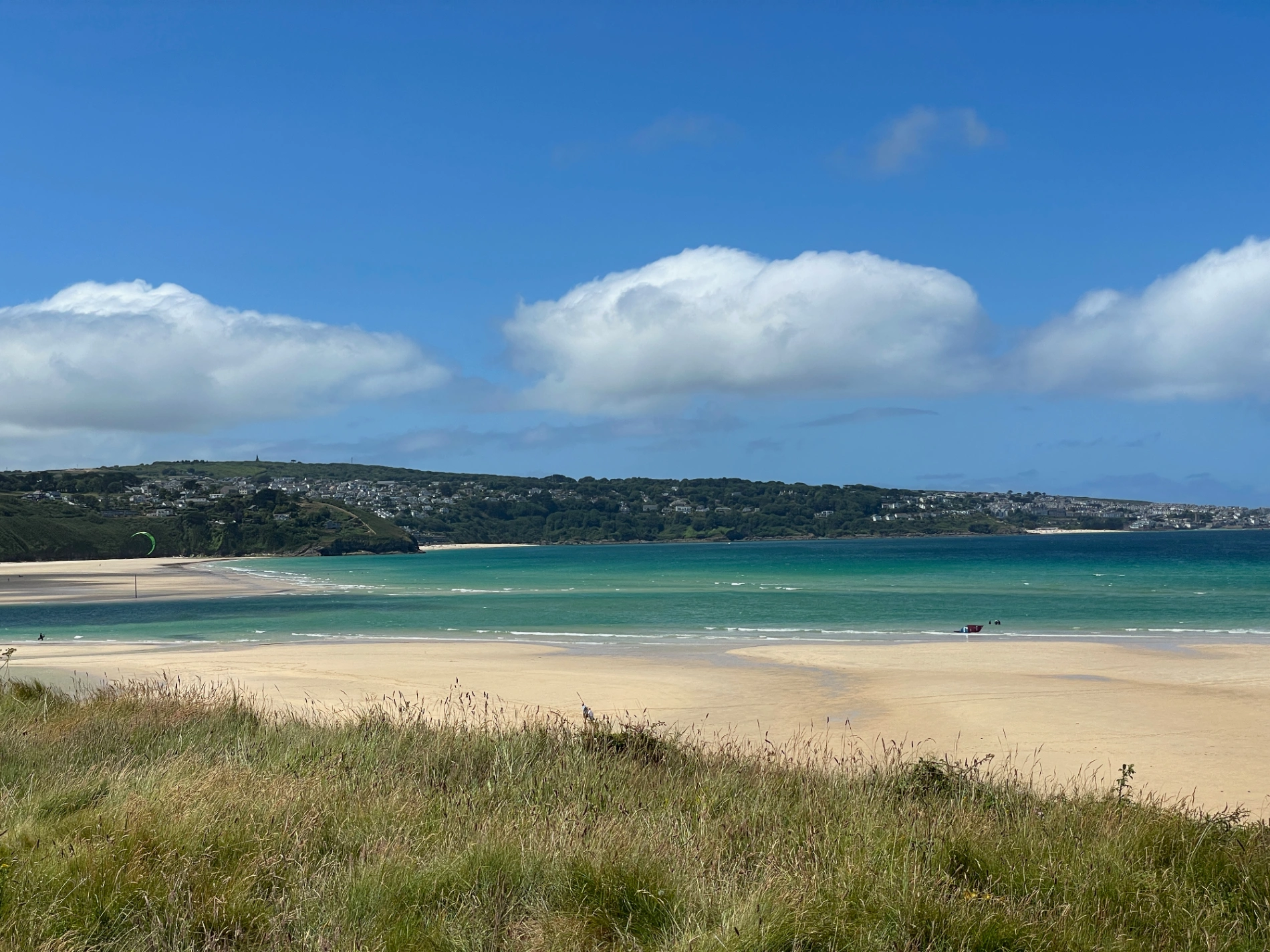
Beach by Beach, Your Complete Guide to Every Beach in St Ives Bay
One of the first questions we get from guests is a simple one, which beach should we actually go to?
St Ives Bay is not short of sand, in fact it has around six miles of it, and most visitor guides only ever mention two or three names. The truth is there are at least eight distinct beaches and named stretches curving round this bay, from Porthminster on the St Ives side, right round past Hayle's three miles of Towans, to Gwithian and Godrevy at the far end. Here is the proper, complete rundown, so you can actually choose the right one for your day rather than just ending up wherever is easiest to park.
Porthminster Beach, the one for a gentle family morning
Tucked on the quieter, eastern side of St Ives, Porthminster is a crescent of golden sand a short walk from the station, backed by grassy hillside and Edwardian villas. It is sheltered, gently shelving and generally calm, which makes it one of the best family beaches in the whole bay, and it holds Blue Flag status to prove it. There is an 18 hole mini golf course right on the beach, along with the acclaimed Porthminster Beach Cafe, public toilets and showers. Lifeguards are on duty through the main season, and dogs face the standard seasonal restriction, banned from 15 May to 30 September, 10am to 6pm, welcome outside those dates and hours. Parking is at the station car park, which fills quickly in summer.
Porthmeor Beach, the one for surfers and sunsets
Porthmeor sits right on the edge of St Ives town, backed by the Tate gallery, which tells you something about the light here before you even get your towel down. It is half a mile of golden sand facing straight into the Atlantic, which makes it the most reliable surf beach on the St Ives side of the bay. There are surf schools operating from the western end for anyone who wants a lesson, and two cafes, Porthmeor Beach Cafe, open year round, and West Beach, open from Easter through September, both with sea views worth the trip alone.
RNLI lifeguards patrol between 10am and 6pm from the Easter bank holiday through to the end of October, and the beach is walkable straight from the town centre. The car park fills early in season, so if you are driving, get there before 9am or plan on the Island or Barnoon car parks instead. Dogs face the same seasonal restriction as Porthminster, 15 May to 30 September, 10am to 6pm.
Carbis Bay, the one for families and calm water
A mile east of St Ives, Carbis Bay is a different kind of beach altogether. It is wide, sheltered and backed by pine covered cliffs, and the water is noticeably calmer than Porthmeor, which is exactly why it is such a hit with families with younger children. The sand is soft and pale, there is a beach shop, baby changing facilities and accessible toilets, and the Ocean Sports Centre hires out kayaks and paddleboards if anyone fancies exploring the bay from the water rather than the sand.
Its Blue Flag status is well earned, and lifeguards are on duty through the main summer season. Parking right on the beach is limited and not cheap, so most locals either walk down from Carbis Bay village, take the train from St Erth or St Ives station which stops right by the beach, or use the long stay car park at Porthrepta and accept a short uphill walk back. The same seasonal dog restriction applies here too, 15 May to 30 September, 10am to 6pm.
The Towans, three miles of beach most visitors never properly explore
Round the other side of the bay, between the mouth of the Hayle estuary and Gwithian, sits a three mile run of golden sand and dunes that locals simply call the Towans, Cornish for sand dunes. It is not one beach, it is several, each with its own name, and it is where you will find far more space and far fewer people than anywhere else in the bay, even in August.
Riviere Towans sits closest to the estuary mouth. Access is via steps and slopes down from the holiday parks above, RNLI lifeguards cover the main season, and it is a genuine hub for watersports, kite surfing, sailboarding and paddleboarding, with international surfing competitions held here in the right conditions. Dogs are welcome year round across most of Riviere Towans, though the narrow strip of sand right between the Hayle river mouth and Black Cliffs carries its own daytime restriction from Easter to 1 October, so stick to the main beach if you are visiting with a dog in that window.
Mexico Towans, in the middle of the stretch, gets its unusual name from the Cornish miners who once emigrated to Mexico for work and brought the name home with them. It is also known locally as Sandy Acres, and it is a genuinely lovely spot, fine golden sand backed by high dunes covered in marram grass, a small cafe operating out of a shipping container, and gentle enough waves that it is a good spot for children learning to surf. Despite a large holiday park sitting behind it, it rarely feels crowded. Dogs are welcome year round, and RNLI lifeguards cover it from mid May to the end of September.
Upton Towans, just behind and alongside the beach here, is worth knowing about even though it is not really a swimming spot. It is a proper nature reserve, home to the rare silver studded blue butterfly and other dune specialists, with the atmospheric, overgrown remains of a Victorian dynamite works scattered through the dunes, once known locally as Dynamite Towans. If you want a proper wildlife walk rather than a beach day, this is where to come, best for butterflies in June.
Hayle Towans itself is wide, flat and remarkably uncrowded considering how close it sits to the caravan parks above. At low tide it merges with its neighbours into one enormous stretch of sand, and the flat open space makes it popular for sand yachting and kite buggy racing, an activity you will not find anywhere else in the bay. There are rock pools and sandy pools at low tide too. Dogs are allowed here all year round, and lifeguards cover the beach from early May to the end of September plus Easter weekends.
Gwithian Towans, the one for surf and space
Continue round towards Godrevy and you reach Gwithian Towans, part of the same run of sand but with its own distinct feel, wilder and more open, with dunes rather than cliffs behind it. Locally the surf break here is known as Sheep Dips, and cross shore winds make it popular with windsurfers and kitesurfers as well as regular surfers. It is slightly more sheltered than neighbouring Godrevy, so the waves tend to be a touch more forgiving for less experienced surfers.
There is a cafe and beach shop by the main car park, and the Jam Pot Cafe, a restored nineteenth century coastguard lookout, serves food with genuinely spectacular views over the bay. Lifeguards cover the beach from early May to the end of September, plus Easter and October weekends. The rock pools here are some of the best in the bay for children. Dogs are welcome year round, though not every section allows them, so check the signage when you arrive.
Godrevy, the wild end of the bay
Godrevy is not really a beach in the traditional sense, more a dramatic headland with rock pools, big surf and one of the most photographed lighthouses in Britain, the one that inspired Virginia Woolf. It is best known for its seal colony, which hauls out on the rocks at Mutton Cove just below the National Trust car park, easily visible without disturbing them if you keep to the path. Bring binoculars if you have them.
So which one should you choose?
If you want a gentle family morning close to St Ives town, go to Porthminster. If you want surf and a proper Cornish town on your doorstep, go to Porthmeor. If you have young children and want the calmest water in the bay, Carbis Bay is hard to beat. If you want space, wildness and a slower pace, head for the Towans, Mexico or Hayle Towans for a proper beach day, Upton Towans if you fancy a wildlife walk instead, and Gwithian or Godrevy if surf and seals are the priority. The good news is that the whole bay is close enough together that you can genuinely try several of these on the same trip, which is exactly what most of our returning guests end up doing.
Browse our properties across St Ives Bay and pick a base that puts you within easy reach of whichever beach takes your fancy, or all of them.